

⭐️ Announcing Sigrid IDE integrations for
Visual Studio Code,
JetBrains, and
Mendix Studio Pro.
You can use these integrations to check Sigrid findings as you work on your code, triage findings, and export findings to your issue tracker if you're not able to fix them right away.
Have you tried them? We'd love your feedback: Share it in our short survey.
You can use these integrations to check Sigrid findings as you work on your code, triage findings, and export findings to your issue tracker if you're not able to fix them right away.
Have you tried them? We'd love your feedback: Share it in our short survey.
Library management overview
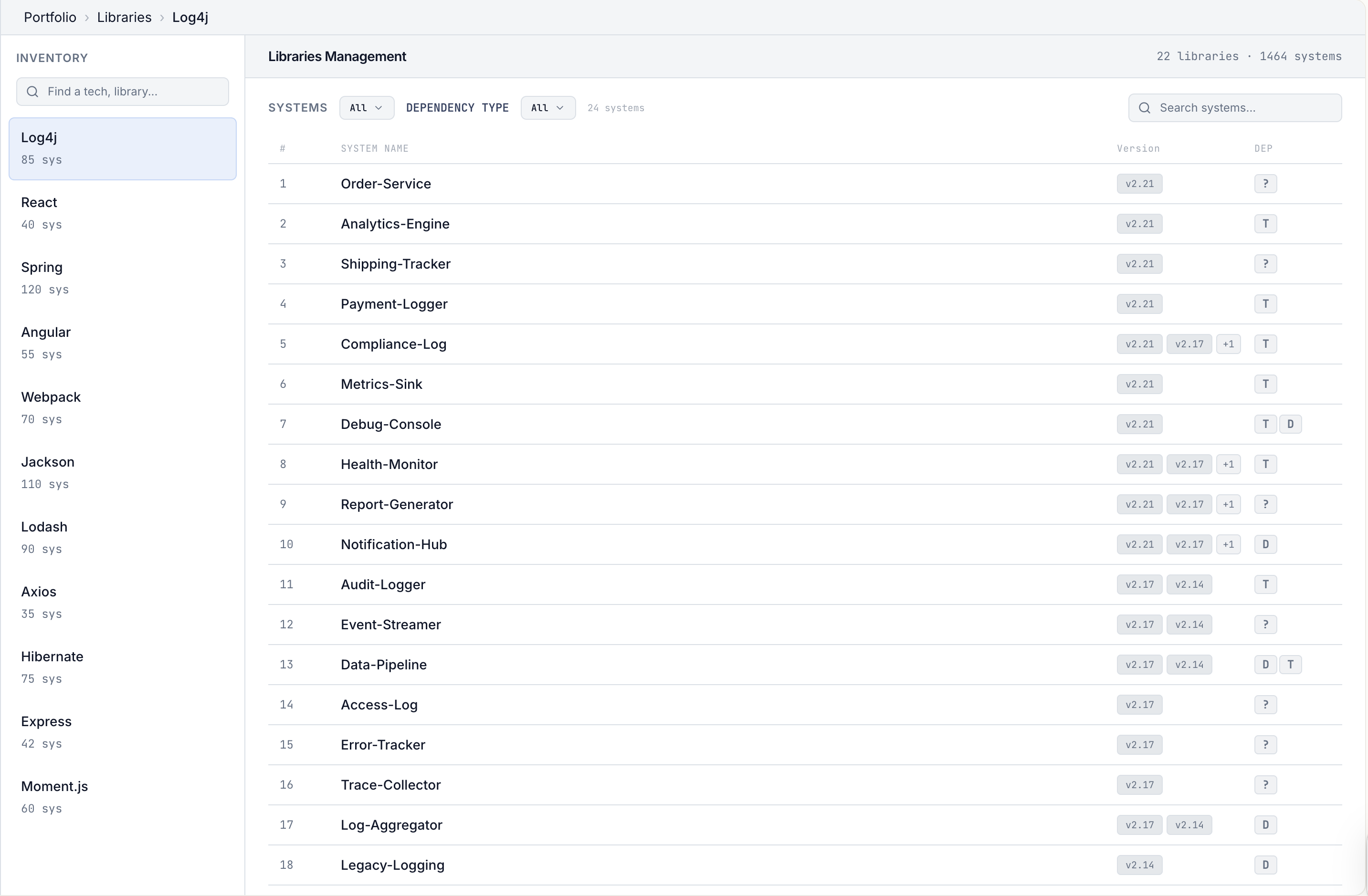
The library management overview page is a portfolio management feature that provides a centralized view to track, analyze, and manage open source libraries (such as Log4j, React, or Spring) across your entire software portfolio.
In summary, this view helps you maintain secure and standardized open source policies by answering:
- Which open source libraries are currently used across our portfolio?
- Which systems are running versions with known security vulnerabilities (CVEs)?
- Are certain systems lagging behind our organization’s version policies?
- If a specific library is compromised, which systems are affected?
When to use the library management overview
- Rapid incident response: When a new vulnerability (like Log4Shell) is announced, use this page to immediately identify every system in your organization that is at risk.
- Tech stack standardization: Monitor open source usage to identify systems lagging behind or not adhering to your organization’s open source usage policies.
- Audit readiness: Export the information, either from the dashboard or using the API, to provide evidence of dependency tracking and licensing oversight.
Information displayed in the library overview
- The inventory column lists all identified technologies (such as Log4j, React, Spring, Angular).
- Use the search bar to quickly locate a specific open source library.
- The system count indicates how many systems currently use a specific open source library (for example, 85 systems in your portfolio use Log4j).
- The system management table is based on the currently selected open source library, and shows where and how
this library is used in your portfolio. It displays the following information:
- The system name where the library is found.
- The version(s) of the library detected in that system. Multiple versions may appear if the system has nested dependencies.
- The dependency type, indicating if the library is direct (“D”) or transitive (“T”).
Contact and support
Feel free to contact SIG’s support team for any questions or issues you may have after reading this documentation or when using Sigrid.